Introducing Clarke Ranch
A Debut Vintage Two Decades in the Making
At Rhys Vineyards, new vineyards are not added lightly. Each one represents years—often decades—of study, patience, and conviction. We don’t plant new vineyards to chase trends or follow the pack. We plant them because the land calls to us and inspires us to do so. Clarke Ranch is such a place.
Although its first wines arrive with the 2023 vintage, Clarke Ranch is the result of more than twenty years of exploration, observation, and quiet persistence. Years before the first vines were planted, we were already searching—walking remote hillsides, studying soil maps, installing weather stations, tasting wines from neighboring sites, and asking where Pinot Noir and Chardonnay might still achieve true greatness in California.
That search kept leading us back to one conspicuously unexplored stretch of the map: the rugged coastal highlands of northern Mendocino County. We wondered, “Why are there almost no vineyards planted between Anderson Valley and the Oregon border?” The more we studied and explored the region, the more we grew to understand that the viticultural fundamentals were compelling—elevation, proximity to the Pacific Ocean, fractured volcanic geology, and a cool, even climate that we soon discovered bore a striking resemblance to Burgundy.
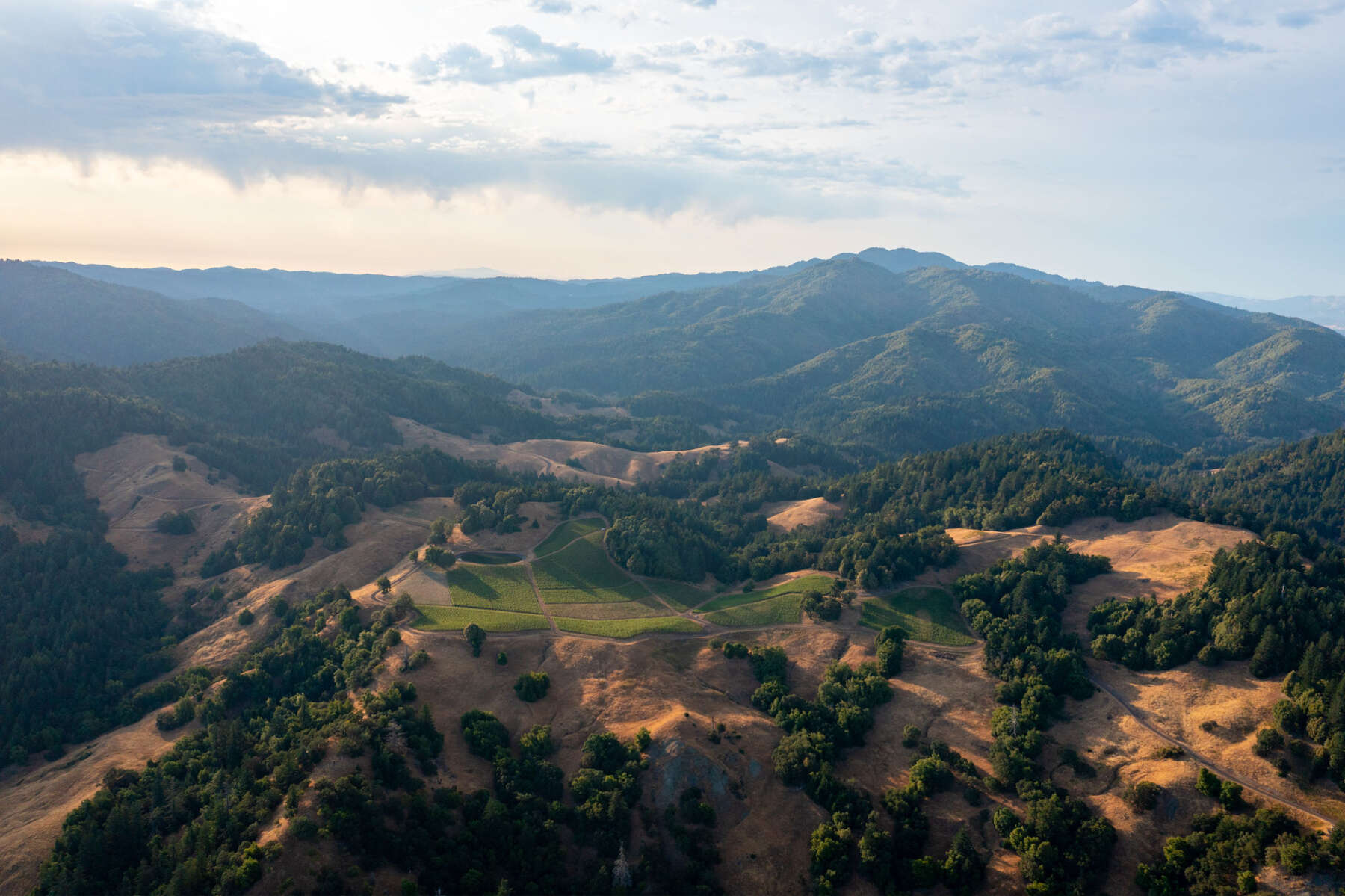
When Clarke Ranch first came to our attention, it immediately felt special. Long before European settlement, the land that is now Clarke Ranch was part of the home of the Cahto people (Kato), whose name loosely translates as “People of the Lake,” a reflection of the waterways and valleys that shaped life in these coastal highlands. The historic property was later settled in 1869 by English botanist Thomas Clarke, encompassing more than 4,500 acres of rolling, ocean-facing ridges, oak woodlands, and open grasslands. Though far larger than anything we had intended to acquire, the land itself was extraordinary. The clay topsoil weathered from fractured volcanic schist, basalt, and chert were exactly the kind we had learned over decades of farming define the qualitative ceiling for great wine, especially Pinot Noir.
Still, we moved slowly and deliberately. Before planting a single vine, we installed multiple weather stations across the property and collected data over several seasons. We dug countless soil pits, walked the land repeatedly, watching how fog moved, where cold air drained, and how exposures shifted across the ridges. The data confirmed what instinct suggested: monthly average temperatures, daily highs and lows, and growing degree days aligned strikingly closely with those of Burgundy’s Côte d’Or.
Over time, one section of Clarke Ranch consistently distinguished itself: a south-facing, twenty-acre slope at roughly 2,000 feet, with excellent air drainage, fractured bedrock, and a natural balance of sun and marine influence. In 2016, we took everything that we had learned planting our Santa Cruz Mountain vineyards and Bearwallow Vineyard in the Anderson Valley and began planting Clarke Ranch.
In that sense, Clarke Ranch shares an important lineage with Mt. Pajaro. Both vineyards were planted with the advantage of hindsight, drawing on decades of experience refining clonal selection, rootstocks, vine spacing, and block design. At Clarke, we planted at high density (4’ x 3’) using Rhys selection massale material, carefully matched to soil depth and aspect. Several blocks were planted on their own roots, an intentional risk in such a remote site, but one we felt confident taking given the vineyard’s isolation. The early results, particularly in the aromatic clarity and mineral expression of both Pinot Noir and Chardonnay, have been striking.
As with many great sites, Clarke Ranch presented challenges alongside its promise. Despite years of climate data suggesting minimal frost risk, damaging frost events in 2021 and 2022 delayed our first official vintage. Even so, we made wine in those vintages and learned a great deal by doing so. We also adapted our farming and installed wind machines integrated with the site’s natural slope and air drainage, significantly reducing frost pressure and giving the vineyard the protection it needed. These measures have proven effective, and Clarke is now well positioned for consistency moving forward.
When the vineyard finally delivered its first complete, unhindered harvest in 2023, the timing felt fitting. The 2023 growing season was long, cool, and remarkably even—the kind of year that rewards patience and reveals site character with unusual clarity. Ripening unfolded slowly, acids remained vibrant, and extended hangtime allowed for exceptional aromatic development without excess sugar or weight.
From the earliest fermentations, it was clear that Clarke Ranch was speaking in its own voice. The Pinot Noir is red-fruited, lifted, and deeply earthy, trading some of the power of our Santa Cruz Mountain sites for a more Burgundian sense of elegance, mineral depth, and age-worthiness. The Chardonnay is crystalline and radiant, defined less by fruit than by texture and minerality. Planted in a cooler fold of the vineyard, the Chenin Blanc mirrors those same qualities with remarkable precision and energy.
While we have yet to share our debut vintage widely with the press, the early response to the wines has been both validating and inspiring, with Billy Norris of Vinous describing Clarke Ranch as “already punching at the same level as the other estate vineyards,”—high praise for a debut vintage, and a meaningful confirmation of the vineyard’s potential.
Like all of our estate vineyards, our 20-acre Clarke Ranch is farmed organically by our own in-house team (including a vineyard manager who lives on the property), with the remaining 4,500-plus acres preserved in their natural state. It’s a majestic place filled with oak woodlands, ridgelines, and coastal valleys, and we are proud to be its stewards. In many ways, Clarke Ranch feels less like an addition to our lineup of estate vineyards and more like a culmination, offering a synthesis of everything we have learned about geology, climate, vine density, and restraint over the past three decades. It is likely the last vineyard we will plant, with the potential to be one of our finest. The 2023 wines are only the beginning. While the vineyard has already achieved a remarkable level of maturity, as the vines continue to age and the roots dig ever deeper, Clarke Ranch will continue to reveal new layers of depth and complexity. After two decades, Clarke Ranch is finally having its moment. We are proud to introduce you to Clarke Ranch and excited to watch its story unfold for decades to come.